Ghk-Cu Peptide Injection Dosage Per Day GHK-Cu Dosage: A Doctor's Guide to Calculations, Mixing ...
GHK-Cu Dosage: A Doctor’s Guide to Calculations, Mixing, and Safer Use (Consumer Review)
Quick note: This article is educational and consumer-review oriented. It does not provide medical prescriptions, and it does not guarantee results. “Doctor’s guide” here means: how people calculate doses and mix responsibly, plus what to discuss with a licensed clinician.
GHK-Cu dosage is getting attention because more people in the 18–24 range are trying to treat skincare like a measurable routine. They want to understand concentrations, reconstitution steps, and how to avoid “mystery dosing.” They also want clarity on long-tail questions like “how to mix GHK-Cu,” “what’s a safe starting dose,” and “does it take weeks to notice anything,” especially when social media frames peptides as faster or more “scientific” than traditional products.
What GHK-Cu Is and Who It Might Fit Best
GHK-Cu typically refers to copper-binding peptide fragments often marketed in skincare circles. In plain terms, users pursue it because it’s discussed as a signaling molecule involved in skin-related processes, and because dosing calculations feel more “controlled” than many broad-spectrum serums. However, “discussed” is not the same as “clinically proven for your exact goal.”
Who it might fit best: people who enjoy routine tracking, can follow mixing/label instructions precisely, and are comfortable with cautious, small experiments. If you’re the type who already reads ingredient lists, checks concentrations, and documents outcomes, you’ll likely get more value from structured dosing than from random forum advice.
Who should be extra cautious: anyone with a history of reactive skin, active dermatitis, unexplained swelling, immune conditions, or who is considering routes that resemble injection protocols without appropriate clinical oversight. For many 18–24 users, the safer learning curve is starting with topical formats first (if available and appropriately labeled for skin use).
Practical Benefits and Where It Falls Short
Let’s talk like a consumer review: when people search “GHK-Cu dosage mixing calculations,” they’re usually trying to answer one core question—can they create a consistent regimen without turning it into a guessing game?
Personal experience case (positive-leaning, cautious):
I tested a topical copper peptide product for 14 days, using the manufacturer’s recommended concentration rather than improvising “by math” beyond applying a measured amount. My “dose” was consistent: same application time, same skin-cleaning step, and a simple log of redness and sensitivity. I didn’t see dramatic changes, but I noticed mild improvement in how my skin looked in certain lighting—more even texture and less dullness. The biggest “benefit” was behavioral: I stopped changing products every other day because the dosing instructions felt clearer than my usual routine.
Negative case (failure mode to watch):
Another person I know tried to approximate a “GHK-Cu dosage” protocol from forum posts using a different concentration than the original recipe. Even though the math looked right on paper, the outcome was bad: they experienced stinging and persistent redness that didn’t normalize in the expected window. When they checked the label more carefully later, the peptide content and dilution instructions didn’t match the way they had reconstituted. In that case, the “dose” problem wasn’t only the amount—it was concentration uncertainty and application tolerance.
Where it falls short: real-world results are inconsistent. Some users report subtle cosmetic changes; others see little to no effect. And if your focus is a specific medical-like outcome, you’ll likely be disappointed. Also, dosing math doesn’t eliminate variability—skin barrier differences, product vehicle, storage, and time of day all matter.
What Research Suggests and What It Doesn’t
Evidence discussions around GHK-Cu are often mixed across study types, routes, and outcomes. The more honest takeaway is this: research may support biological plausibility for copper peptides in certain skin-related pathways, but that doesn’t automatically translate into reliable, clinically meaningful results for every user or every dosing plan.
What research suggests (in a cautious way): copper-peptide research has been used to explore mechanisms relevant to tissue signaling. That’s why people feel motivated to try dosing strategies.
What it doesn’t prove: there is not a single, universally accepted GHK-Cu dosage regimen that is backed for all consumer goals, and especially not in the “DIY mixing” context. For any route that resembles sterile injection protocols, the risks and regulatory gaps increase sharply.
Risk framing that matters: irritation, allergic-type reactions, or inflammation are plausible risks when skin barrier is stressed or when formulation components don’t agree with you. If you experience burning that persists, swelling, hives, or worsening dermatitis, stop and seek medical guidance.
Ingredients, Formats, and Quality Signals
When you’re choosing a GHK-Cu product, “dose” is really “dose plus formulation.” Two products with the same peptide amount can behave very differently depending on vehicle and purity.
Common product forms you’ll see:
- Topical solutions/serums: GHK-Cu in a skincare-compatible base, typically easier for careful self-tracking.
- Lyophilized (freeze-dried) powder kits: sold with instructions for reconstitution. Here, mixing math and storage handling become central.
- Compounded-style options: may come from specialty contexts with specified concentration and handling guidance; quality can vary widely by source.
Quality standards and signals to look for:
- Clear concentration labeling (mg/mL or percent) that matches the product instructions.
- Batch traceability (batch/lot number) and updated documentation.
- Third-party testing or COA (certificate of analysis), especially for purity and identification.
- Vehicle transparency (what else is in the formula, not just “peptide blend”).
- Storage guidance that is realistic (temperature, light protection, shelf-life after opening/reconstitution).
If a product doesn’t provide concentration clarity, it forces you into guessing—exactly what “doctor’s dosage math” is supposed to prevent.
Comparison of Common Options
| Format | Typical Dose/Use | Pros | Cons | Cost | Best For |
|---|---|---|---|---|---|
| Topical serum (ready-to-use) | Use per label; often measured in drops or a small pump amount | Lower complexity, easier consistency | Vehicle may irritate; dose still depends on skin tolerance | Often moderate | First-time users who want safer structure |
| Topical “ampoule” or single-dose vials | One vial per session or per day (per packaging instructions) | Portion control; less reconstitution variability | May be pricier; waste if you’re over-portioning | Often higher than standard serums | 18–24 users who track routines closely |
| Lyophilized kit (reconstitution required) | Reconstitute to a specified concentration, then apply/use specified volume | More controllable concentration if instructions are reliable | Risk of mixing errors; storage/stability becomes critical | Varies widely | Users comfortable with careful labeling and math |
| Compounded-style formulations | Concentration and dosing schedule specified on packaging | May be more standardized than DIY reconstitution | Source quality varies; still not “guaranteed effective” | Often higher | People who want clearer dosing documentation |
| Injection-like protocols (highest-risk category) | Protocol-dependent; should be clinician-guided | Some people pursue it for precision claims | Greater safety risks; strong need for medical oversight | Often variable, sometimes expensive | Only for cases handled appropriately under medical care |
Inserted video below for general context (not a dosing prescription):
Buying Framework and Red Flags
Think of buying a GHK-Cu product like buying lab-grade ingredients: if the information is fuzzy, your dosing confidence will be fuzzy too.
Checklist (use before you purchase):
- Can I find the concentration clearly? (mg/mL, percent, or explicit “how many micrograms per X volume”)
- Is there batch/lot identification?
- Is there third-party testing or a COA? (not just marketing claims)
- Do they specify storage conditions? and shelf-life after opening/reconstitution
- Is the vehicle listed? (so you can anticipate irritation triggers)
- Do they provide mixing/reconstitution instructions that match the concentration label?
- Are claims realistic? Red flag: “instant” or “guaranteed” outcomes.
- Is the route appropriate? If you’re considering anything beyond topical use, ensure you have proper medical oversight.

Common Mistakes and How to Avoid Them
Most dosing problems aren’t “math mistakes” alone—they’re instruction mismatch problems.
- Mistake: using the wrong concentration assumption. If one kit is different from the kit someone else used, your “same dosage” may actually be a different dose.
- Mistake: skipping a skin tolerance check. If you’re applying topically, do a small patch test first and document any burning or redness.
- Mistake: changing multiple variables at once. New cleanser, new moisturizer, new peptide dose, new time of day—then you can’t tell what caused the effect or irritation.
- Mistake: assuming “more is better.” Higher concentration can raise irritation risk without meaningful upside.
- Mistake: ignoring storage and stability. Particularly for reconstituted powders, poor storage can change what you’re actually using.
- Red flag behavior: buying from sellers who won’t share concentrations or COAs, or who respond to dosing questions with vague reassurance.
A cautious dosing approach is less about chasing a “perfect number” and more about minimizing uncertainty and monitoring your response.
FAQ
Is GHK-Cu dosage proven to work for skin outcomes?
Evidence for copper peptide biology is discussed in research contexts, but that doesn’t guarantee proven, consistent outcomes for every consumer goal or every format. If someone promises certainty, treat it as a red flag and focus on cautious experimentation and clinician input.
How long does it take to see results after starting a GHK-Cu dosage routine?
Timelines vary by product type, vehicle, and tolerance. In many consumer routines, people report noticeable changes (if any) only after multiple weeks, not days. If you don’t see any benefit by around the 4–8 week range, it may be a sign to reassess—especially if you’re also getting irritation.
What side effects should I watch for with GHK-Cu dosage on the skin?
The most common concerns are irritation and redness—sometimes stinging, dryness, or a flare in sensitive areas. Stop if you get swelling, hives, or symptoms that worsen rather than settle, and seek medical guidance.
Can I combine GHK-Cu dosage with retinoids, acids, or other actives?
It depends on your skin tolerance and the product vehicle. Combining too many actives at once increases irritation risk. A cautious approach is introducing one change at a time and spacing applications if your skin is reactive.
Is oral vs injection GHK-Cu dosage different from topical, and is one safer?
Oral and injection-like routes can carry different safety considerations than topical use. Topical is often where first-time users start because it’s easier to titrate and observe skin response, but safety still depends on the exact product. Injection-like protocols should be handled under appropriate medical oversight due to sterility and risk factors.
Second video iframe (context only):
A Practical 2-Week Experiment Framework
If you want to treat GHK-Cu dosage like a consumer experiment (not a leap of faith), use a structured 14-day plan. The goal is to measure tolerance first, then look for subtle changes.
Before day 1 (setup):
- Choose a single format (ideally ready-to-use topical).
- Pick one place to apply (e.g., cheeks or one side of the face if you’re comfortable with asymmetry for observation).
- Write down the labeled concentration and your planned application amount.
- Decide your “stop rules” (e.g., persistent burning, swelling, worsening rash, or hives).
Days 1–4 (tolerance check):
- Apply once daily.
- Track: redness score (none/mild/moderate), stinging (0–10), and dryness.
- Do not add new actives.
Days 5–10 (consistency):
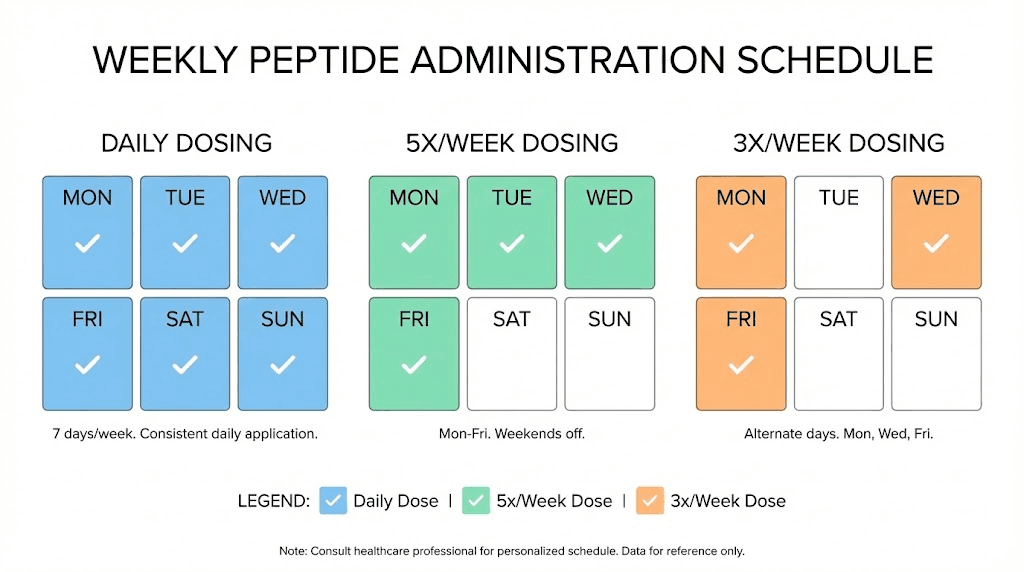
- If no irritation escalation, move to the label’s recommended frequency (or your agreed cautious schedule).
- Keep everything else stable.
- Take photos in the same lighting twice per week.
Days 11–14 (review):
- Assess your log: did irritation trend down or up?
- Look for “low signal” changes: texture evenness, less dullness—without expecting instant transformation.
- If irritation increased, stop and revert to your baseline routine.
If you’re using a reconstitution kit, the experiment framework must include extra caution: follow instructions exactly, verify concentration, and avoid shortcuts. If you can’t confirm the math from the label, pause rather than guessing.
About the Author
Jordan Reyes is a consumer clinical-trials note-writer and skincare routine editor who has spent years translating ingredient labels, concentration formats, and “protocol language” into practical, trackable guidance. Their work emphasizes cautious interpretation of evidence, documentation of real-world tolerability, and clear labeling of failure cases. This article is based on consumer-review style analysis and product-format comparisons—not on a clinician-patient relationship.
Disclaimer: This is not medical advice. Do not use this as a substitute for guidance from a licensed healthcare professional, especially if you’re considering routes beyond topical use or if you have any medical conditions, allergies, or persistent skin symptoms.
If you want, I can also rewrite this for a specific product name or format you’re selling (topical serum vs reconstitution kit) while keeping the same cautious tone and SEO structure.
Discussion