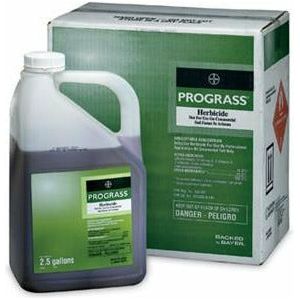
ethofumesate herbicide Bayer Prograss EC Herbicide
SKU: 56385037404
ethofumesate herbicide

ethofumesate herbicide Bayer Prograss EC Herbicide

Sale price$22.00 Regular price$24.44
Save 10%

Pay in installments of $6.11 with ShopPay, AfterPay and Klarna

Shipping Estimate
USA
  • USA
  • CAN

Ships within 48 hours · Estimated delivery Jul 6 - Jul 11

Promo Codes Available:

For Your Every Summer RSVP, with Code: SUMMER15

Description

ethofumesate herbicide Bayer Prograss EC HerbicideBayer Prograss EC Herbicide Bayer Prograss EC Herbicide is your year round solution for Poa annua and a spectrum of common annual grasses in cool season turf and overseeded bermudagrass. This ethofumesate based emulsifiable concentrate delivers both pre and post emergent control, meaning you can target Poa annua from germination through active growth across all seasons. With a flexible Prograss program, you can tailor treatments to your specific turf

Bayer Prograss EC Herbicide

Bayer Prograss EC Herbicide is your year-round solution for Poa annua and a spectrum of common annual grasses in cool-season turf and overseeded bermudagrass. This ethofumesate-based emulsifiable concentrate delivers both pre- and post-emergent control, meaning you can target Poa annua from germination through active growth across all seasons. With a flexible Prograss program, you can tailor treatments to your specific turf type and climate, keeping lawns, golf greens, sod farms, and other turf surfaces cleaner and healthier year after year.

What makes Prograss EC stand out

  • Two-pronged weed control – active before and after Poa annua germinates, plus suppression of a broad array of annual grasses and certain broadleaf weeds.
  • Season-spanning effectiveness – designed to work across cool and warm periods, making it suitable for continuous Poa management in every season.
  • Broad turf compatibility – recommended for bentgrass, tall fescue, St. Augustinegrass, Kentucky bluegrass, and perennial ryegrass, with specific notes for bermudagrass management in St. Augustinegrass systems.
  • Climate versatility – effective in both humid and arid climates, giving turf managers flexibility no matter where you play or live.
  • Real-world uses – approved for golf course fairways, sod farms, cemeteries, and both commercial and residential lawns, making it a versatile choice for professionals and homeowners alike.

What it controls and where to apply

  • Poa annua (annual bluegrass) and a range of annual grasses including crabgrass, barnyardgrass, large and smooth crabgrass, green foxtail, yellow foxtail, and canary grass.
  • Selected broadleaf weeds such as white clover and common chickweed, offering broader weed suppression in a single program.
  • Suitable for overseeded bermudagrass and established cool-season grasses in greens, fairways, tees, and residential lawns.

How to use

Rate of use is 1.5 to 6 fluid ounces per 1,000 square feet, depending on turf type and labeling. For best results, follow the label directions on timing, tank-mixing restrictions, and required intervals between applications. Calibrate your sprayer to deliver uniform coverage and avoid runoff. Consider integrating Prograss EC into a broader turf management plan that includes proper fertilization, mowing height, and irrigation practices to maximize weed suppression while protecting desirable grasses.

Usage scenarios and ideal targets

  • Golf course professionals managing Poa annua pressure on fairways and overseeded areas during transition periods.
  • Sod producers seeking reliable control of annual grasses to protect stand establishment and turf density.
  • Municipal and commercial grounds managers aiming for consistent weed control across lawns, medians, and park spaces.
  • Homeowners with mixed turf lawns featuring bermudagrass overseeding or cool-season grasses, needing a single product to manage Poa annua across seasons.

Practical tips for best results

  • Use Prograss EC as part of a coordinated Poa annua management plan rather than as a one-off solution—consistent applications aligned with Poa germination windows yield the strongest suppression.
  • Match rate to turf type and growth stage; younger, actively growing turf types may respond differently than established stands. Always follow the label for rates and re-entry restrictions.
  • Monitor irrigation and rainfall after application; excessive irrigation soon after treatment can influence absorption, while targeted irrigation helps avoid stress on desirable grasses.
  • Combine with cultural practices such as adjusting mowing height and improving soil health to support dense turf that naturally resists Poa annua encroachment.

Why choose Bayer Prograss EC for your turf care routine

If you’re balancing Poa annua pressure with the realities of climate, soil, and diverse turf species, Prograss EC offers a precise, season-spanning approach that’s flexible enough for golf clubs, sod farms, cemeteries, and home lawns. With a 2.5-gallon supply, you can implement a thoughtful, ongoing program rather than relying on sporadic spot treatments. Ethofumesate at 19% delivers dependable control while respecting the health and performance of your preferred grasses, helping you achieve cleaner greens, more uniform turf color, and improved playability or curb appeal without over-reliance on multiple products.

Shipping Notes
  • Free Standard Shipping on $100+ Orders to the USA.
  • Except Preorder products are shipped in 48 hours.
  • Delivery to the USA:
  1. Standard Shipping : 3-10 business days
  • If time is of the essence, please consider selecting expedited delivery for faster service.
Exchange/Return Notes
  • We offer a 30-day return/exchange service after receiving.
  • Final sale items are not eligible for returns or exchanges.
  • To process your return/exchange, please contact us at [email protected]
  • Please click here for more details>>> Return & Exchange Policy
SKU: 56385037404

Discover Niche Categories That Outsell ethofumesate herbicide

Top-Converting Item to Boost Your Average Order

4.5 ★★★★★
Based on 2440 reviews
Sort
Highest Rating
Newest First
Oldest First
Product Reviews
A
Verified Purchase
allison
Omaha, US
★★★★★ 5
A great reference for Biblical factual archeology
Format: Paperback
I just received this book and I am so excited. It is a great tool and reference for Biblical studies. Each artifact has a great photograph next to the quick eye catching dates, discovery, period, keywords and Biblical passage. Then a brief but to the point description. It is simple and effective. Very easy to refer when reading your Bible or if you are just interested in archeology. Each artifact is about 2 pages and nothing more which is perfect for references. What a great book!
WAS THIS REVIEW HELPFUL?YesReportShare
Reviewed in the United States on March 1, 2025
S
Verified Purchase
sandyrouse
Chelsea, US
★★★★★ 5
Excellent and in-depth archeologic finds that authenticate Bible history.
Format: Paperback
Archeology is proving much of the Bible's history as true. This book really delves into various sites and provides a lot of detail. My type of reading.
WAS THIS REVIEW HELPFUL?YesReportShare
Reviewed in the United States on February 21, 2026
A
Verified Purchase
Angie Criss
New York, US
★★★★★ 5
Great information and pictures
Format: Paperback
Great information on Biblical sites, beautiful pictures, and a pretty book as well. I gave several of these to my family for Christmas. Everyone seemed to love them. The only thing I will caution you about is that the book is small.
WAS THIS REVIEW HELPFUL?YesReportShare
Reviewed in the United States on January 22, 2026
M
Verified Purchase
Mareadas
Houston, US
★★★★★ 4
Knowledgeable and delectable book.
Format: Paperback
This book shows an excellent archaeological evidence of the Bible accuracy of places, names, events, etc. and proving for the Christians that the Bible is a historical document as well as the inspired inerrant word of God. The majority of the book is interesting and delectable, I mean, the pages where the author presents archaeological facts such as the artifacts and their correlation with people, places times, events and practices recorded in the Bible. But I do not like when the author make personal assumptions and do not present any proof of that. He says: it probably be…. it may be… Here I show three cases of this conjectures;: 1.The author seems to affirm that the triumphal entry of Jesus into Jerusalem, or at least, the name of this event, was derived from the Roman triumph celebration. He says (page 231), regarding to the Roman Empire and the life of Jesus: “By the time of Jesus, the requirements and meaning of a triumphal entry had shifted slightly from its earlier roots associating it with a conquering hero, as it became even more significant and representative of kingship and divinity”. He continues to say: “In ancient Roman culture, a triumphant victor, known as vir triumphalis (“man of triumph”) would enter the city in a celebration parade wearing the laurel wreath and a purple garment, which identified him with the royal and the divine, while riding in a chariot pulled by four horses, alluding to Sol the sun god”.  But if we compare the Roman triumph celebration with the entry of Jesus into Jerusalem described in the Bible, it is not derived from the Roman culture but is the exact fulfillment of the prophesy of Zechariah 9:9. I do not see any correlation between the two celebration; Jesus did not ride a horse but a donkey to signify peace, meekness and humility. It was not a pompous entrance of a conquering hero or king wearing a expensive garment and royal crown. 2.Even though, it is not possible to identify the location of the tomb of Jesus with absolute certainty; the author states (page 199) that the tomb of Jesus is located at the Church of the Holy Sepulchre possible based on “the restoration work to the edicule and an arcosolium tomb from the Roman period found in the church of the Holy Sepulchre”. The author also affirms without giving any proof that: “Christians in Jerusalem then passed down a continuous memory of the location of the tomb (of Jesus) from the time of the burial and resurrection in AD33 until construction of the Church of the Holy Sepulchre was started in about AD326”. But where are the records of that time? The author probably based his statement on Eusebius who lived in the 3rd and 4th centuries AD. According to the history , the Church of the Holy Sepulchre was built by the Roman Emperor Constantine around 326 AD, when her mother the Queen Helena, wanted to replace the pagan temples with Christian churches; she met the Bishop Macarious of Jerusalem who determined the location where Jesus had been buried at the place where was a temple to the Greek goddess Venus. At the beginning of the construction of the church, a rock-cut tomb was found there and an edicule was built to protect the site. But later the edicule was destroyed and rebuild. More tombs has been found under this church. How to be sure or verify that this rock-cut tomb was the one where Jesus was buried? 3.The author is biased with respect to the Masoretic Text, he make a statement but does not support it with any evidence in this regard. Writing about the Dead Sea Scrolls (Page 173) he states: “And certain passages in the Masoretic text seem to have been intentionally modified to match ideas and theology of medieval Judaism.” it is a bad accusation.
WAS THIS REVIEW HELPFUL?YesReportShare
Reviewed in the United States on April 23, 2021
H
Verified Purchase
Harold Lau
Charlottesville, US
★★★★★ 5
Great Worth
Format: Paperback
The Book That Must Be Read!
WAS THIS REVIEW HELPFUL?YesReportShare
Reviewed in the United States on April 18, 2026

recommand products